




Featured in the Winter issue of Fly Fusion, married couple Agnieszka and Arek Kubale own and operate Tuhola, a fly-tying company that supplies anglers across Europe with a wide range of flies–from trout and grayling patterns to saltwater offerings. Agnieszka is renown for her UV resin flies and clean tying technique. Arek is a fly-fishing photographer and journalist and has published his work in various fishing magazines. They share their time between houses in Poland and Sweden: one on theBaltic coast in the small fishing village of Junoszyno, Poland. Second located at the salmon river Torne, far in subarctic region of Sweden.
Grab a copy of the current issue to check out their Waddle Shrimp, Bead Eye Chillimps, Black Head Sandeel and Mirage Minnow! In the meantime, enjoy these BONUS patterns.
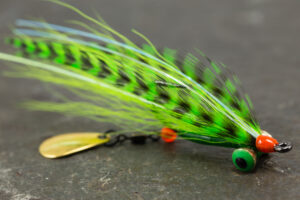
Spinner Blade Clouser Minnow
Hook: Ahrex NS110, size #4
Thread: UNI-Thread 6/0, orange
Spinner blade: Colorado Spinner Blade, gold, size 0
Spinner blade mount: soft predator wire, swivel and split ring
Eyes: dumbbell eyes 4,8 mm, green
Body: UNI-Thread Floss, fluo green, covered with UV resin, clear
Wing: bucktail and rooster neck feathers, chartreuse; Flashabou, opal mirage
Head: UNI-Thread 6/0, orange
Tying tips: be sure to use a good quality swivel. Also, note the proper point of mounting dumbbell eyes. In original Clouser Deep Minnow it should be tied in at 1/4 or 1/3 of hook shank length from the hook eye and so it goes in this variant as well.

Vaskebjørn (The Raccoon)
Hook: Ahrex NS156 Traditional Shrimp #4-6
Thread: UNI-Thread 6/0, tan
Tail: wide and webby rooster saddle hackle, grizzly
Eyes: bead chain eyes 3,8 mm, black
Body (section 1): seal fur dubbing, red
Hackle 1: wide and webby rooster saddle hackle, grizzly
Body (section 2): SLF Saltwater dubbing, sand
Hackle 2: wide and webby rooster saddle hackle, grizzly
Body (section 3): SLF Saltwater dubbing, sand
Hackle 3: wide and webby rooster saddle hackle, grizzly
Head: UNI-Thread 6/0, red
Tying tips: long and wide rooster saddle feather is a perfect choice, since the tail and all three hackles are tied just from one feather. This way you’ll get perfect, tapered shape of this classic Danish seatrout pattern.