




by Danie Erasmus
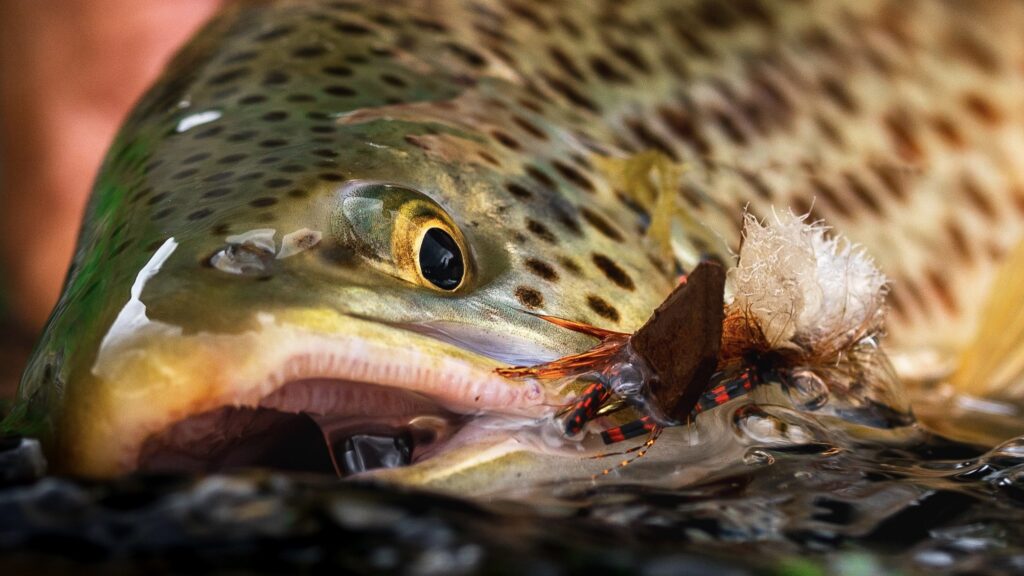
Caddisfly larvae are also important small nymphs. Trout feed on caddis larvae if they have a case, spin a net, or are free-living. Most caddisfly species’ larvae also perform a behavioural drift throughout the season, making them an excellent, easily accessible food source for trout. Many larvae also expose themselves when suspending mid-current with a silk thread that is attached to the substrate. Called rappelling, the larvae attach the silk thread to the substrate and then rappel downstream to new habitat.
The American grannom is one of the more important small caddis as it is present in moderately flowing runs where it’s practical to fish small nymphs. These case-building caddis larvae are easily recognized by the four-sided, chimney-shaped cases they build from small twigs. Grannoms cling to the topside of rocks and aquatic plants, and exhibit the rappelling behaviour. It’s quite common to find these larvae, complete with cases, in a trout’s stomach.
Small free-living and net-spinning caddis are also excellent fish food. Imitating predacious free-living caddis is more challenging, as they occupy fast-moving riffles, but since they actively hunt their prey and move around a lot, they are often washed downstream. Poor swimmers, free-living caddis frequently end up drifting long distances downstream. Net-spinning caddis set up their shelters and nets in more moderate current, water suitable for fishing small nymphs. These larvae leave the safety of their shelters to find food, inadvertently exposing themselves to danger.
The overall the shape of caddis larvae permits the addition of a fair amount of weight when tying small imitations. Tungsten beads and lead wire along the shank of the hook are important components of small caddis larvae imitations.